
The Night Bus Terminus
Short Story

The last bus came in at 2:42 am. The doors hissed. Light spilled onto the turning circle, yellow and sick-looking against the dark. The driver didn’t look up. He never did. Frank had worked the terminus for three years and couldn’t have picked the man out of a police line up.
Frank waited for the engine to cut before stepping out with his mop. He’d learned that early. The diesel smell—earthy, mineral—hung thick when the engine was running, got into your throat and stayed there. Better to wait.
Some nights no one got off at all. The bus would idle, doors open and close like a mouth testing the air, and the driver would lift a hand in a greeting that wasn’t one.
Tonight there were four.
A man with a rucksack and a roll mat clipped across it. He came down the steps fast, walking boots hitting hard, and crossed the empty road without pausing.
The second was a woman in a thin coat, navy or black, holding a carrier bag with the handles torn away so she had to cradle it against her chest. She moved carefully, as if the ground might give.
Behind her, a girl. No, older than that—early twenties maybe, with a canvas bag and earphones in, music scratching. She walked past the shelter and kept going, towards the main road, her head down.
The last was a boy. Fifteen, sixteen. He paused at the top step as if counting, or checking, then came down and stood on the tarmac with his hands in his pockets. He watched the bus leave, face blank in the sodium light.
Frank stood back. Let them find their feet. That was his job, or part of it. The cleaning was straightforward. The rest—the watching, the waiting—that came with the place.
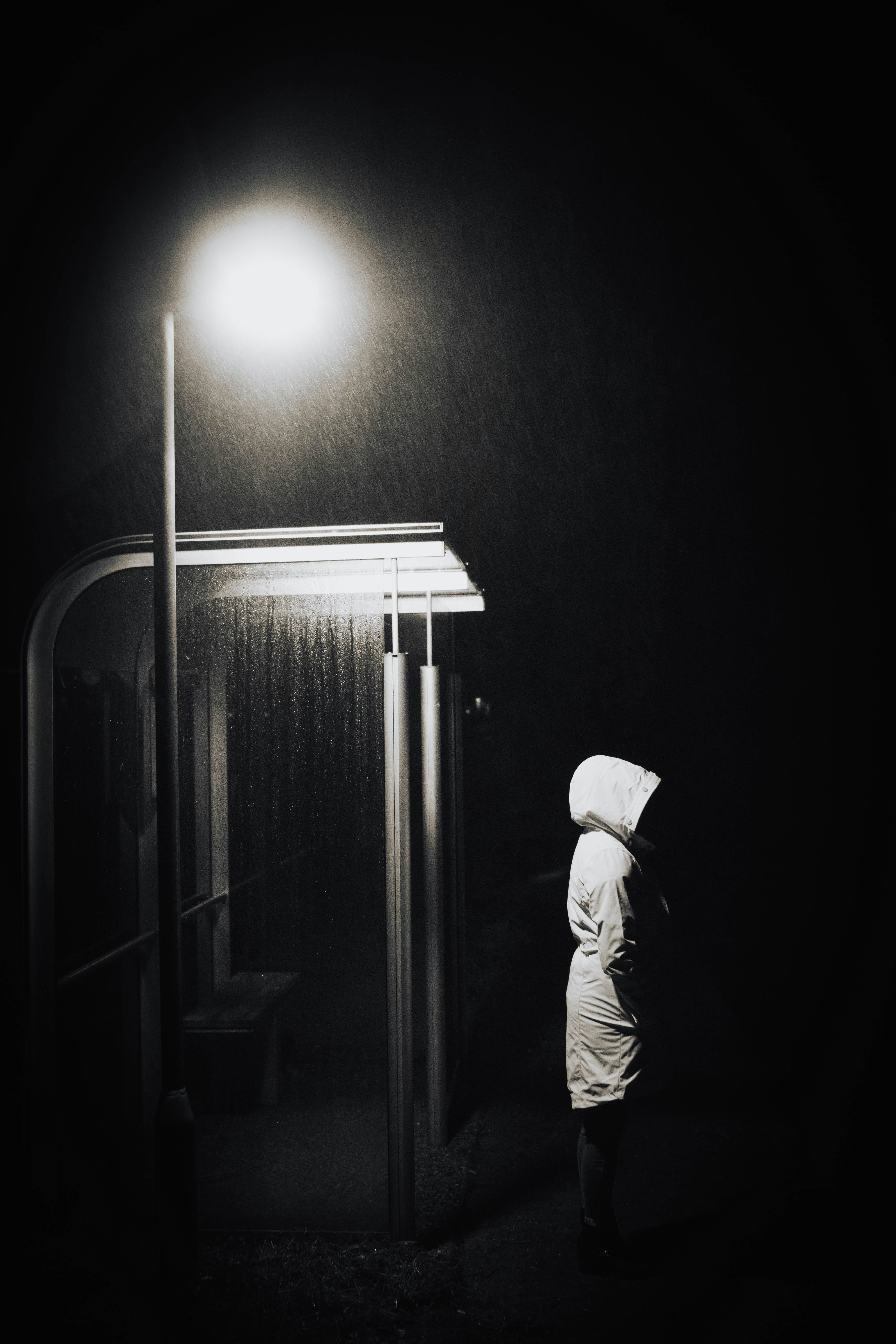
The terminus sat where the town gave up. A tight circle of tarmac laid down against open ground, the shelter bolted to a concrete pad that never quite dried. The glass was clouded with old breath and grit, scratched with initials and landline numbers that probably didn’t work anymore. Beyond it the land fell away, fields stepping down into dark. The river ran somewhere below the road—a moving cold that came up the slope and settled in the low places, pooled around the shelter, pressed against the glass.
The sodium lamp buzzed overhead, casting everything in that sour orange that made everything look temporary. The shelter. The tarmac. The passengers.
The woman crossed to the shelter and stood under it, studying the timetable though it was too dark to read properly and she must have known there were no more buses. The boy stayed where he was, turning slowly, looking back down the road the way he’d come. The sound of the bus faded. The wind came up from the fields, bringing the smell of turned earth.
Frank unlocked the shelter.
He didn’t announce it. The click of the lock was small, metal against metal, a sound that barely carried. He went back to the trolley—a wheeled thing the council had issued him, dented on one side where someone had kicked it—and started to mop where rainwater and diesel oil made a thin sheen that never fully lifted, no matter how often he worked at it. The water in the bucket turned grey-black. He’d learned to bring two buckets. One for the first pass, one for the second.
The woman went in first. She didn’t look at him. She sat on the bench—plastic, bolted down, designed to be uncomfortable—and set the carrier on her knees. The boy followed, slower, then sat at the far end of the bench. Three feet between them. Frank noticed that.
He worked from the edge of the circle inward. This was how he kept things straight. One thing. Then the next. Start at the road. Work to the centre. Don’t skip. Don’t rush. The repetition helped. It was something he’d tell his daughter when she was small and learning to swim. One stroke, then another. Don’t think about the end.
The mop made a wet slapping sound against the tarmac. Frank pushed it in long strokes, overlapping each pass. The water ran to the edges, found the cracks, disappeared. By two the place was clean enough for an inspection it never got. He rinsed the mop in the second bucket, wrung it out—the water running dark between his fingers—and leaned it back against the trolley. He checked the bin. Half full. Cans mostly. A newspaper folded into a damp brick. Someone had left a shoe. Just one. A child’s trainer, blue with white laces. Frank left it on top in case they came back.
Inside the shelter the woman leaned her head against the glass. Condensation bloomed where her skin touched it, then ran in slow lines. Her eyes were closed but Frank didn’t think she was sleeping. The boy hunched forward, hands hanging loose between his knees, his breath showing faintly in the light. His trainers were worn through at the toes. Frank could see the grey of his socks.
Frank locked the maintenance cupboard. The padlock was stiff, needed oil. He made a note to bring some though he never did. He didn’t lock the shelter. That was the point.
He popped his head around the door.
‘You can stay till first light,’ he said.
His voice sounded strange. Too loud. The woman nodded without opening her eyes. The boy nodded too, a quick dip of his head.
Frank sat on the low wall, thermos between his boots. The wall was cold even through his trousers.
The fields breathed in the dark. A car on a distant road. An owl somewhere over the fields. The wind moving through the hedge that marked the field boundary. Somewhere below, the river carried on.
He poured tea into the thermos cup and waited for it to cool. It was too hot to drink but he liked the feel of the cup in his hands, the heat of it.
He had rules. He didn’t write them down. They’d formed over time, shaped by what happened when he didn’t have them.
No names.
No staying two nights.
No arguments.
Leave it clean.
If anyone asked—which they didn’t, not really—he was just the cleaner. He unlocked the shelter because, they assumed, that was his job. But it wasn’t.
The woman coughed. A wet sound that went on longer than it should. The boy pulled his sleeves over his hands. Frank watched without staring.
The boy reminded him of his daughter—not the face, the posture. The way he sat as if braced for something. Correction. A telling-off. The way his shoulders curved in. Frank didn’t follow the thought. He sipped his tea. It was still too hot. He let it sit.
A car slowed as it passed, tyres hissing slightly on damp tarmac. Headlights swept the shelter. The woman, the boy, the bench lit up. Then darkness again, and the sound carrying longer than it should have, the way sound did out here. The fields took it and held it, then let it go.
Frank felt the question rise, the one that came every night and never quite formed. What are you doing? Or maybe, What good is this? He didn’t have an answer. He drank his tea.
The boy stood and went outside. Frank tensed but didn’t move. The boy walked to the edge of the circle, stood there looking out at the dark. Then he came back and sat down. The woman hadn’t stirred.
Later Frank checked the cupboard again, though it was locked. He walked the circle, checking for glass, for needles, for anything sharp. He found nothing. Near four he swept the shelter steps. Leaves had blown in from the field and stuck to the damp concrete. The broom made a scraping sound. Inside, the woman woke and watched him. She didn’t speak. When he finished she closed her eyes again.
At 5:00 am the sky began to thin, light lifting first over the open ground before it reached the houses behind him. It came slowly, grey before it was blue, making shapes out of what had been formless. The hedge. The gate into the field. The line of the road. The river valley opened up, dark green and folded.
Frank opened the shelter. The woman stirred and sat up. Her face looked raw in the new light. The boy was already awake, pulling on his jacket—a puffer jacket, torn at the shoulder, the stuffing coming through.
‘Six ten,’ Frank said. ‘First bus.’
But mostly they weren’t waiting for the first bus to arrive.
They nodded. They knew. They got to their feet and exited the shelter and disappeared in opposite directions down the road.
He locked the door. Stood there with the keys cold in his hand, listening to the river air move past him. Then he unlocked it again. He didn’t know why. The action felt necessary.
He walked home as the town woke. The paper shop pulling up its shutters. A milk float humming past. His house was at the end of a terrace, red brick, the rendering coming away at the corners. He let himself in and stood in the hallway, the silence of the place pressing against him.
He slept badly. The afternoon light came through the thin curtains too early, the kind of light that made sleep impossible. The house made small sounds to prove it was still there. The boiler ticking. A floorboard contracting. He lay and listened and thought about nothing in particular.
It was no use. He got up. Made tea. Ate toast standing at the counter. The kitchen was clean because he kept it that way. No dishes in the sink. No crumbs on the surfaces. It had been different when his wife was around.
He made more tea and stood at the sink. The garden sloped away more than he remembered, as if the land was slowly giving up. Foxes had begun to cut across it at night, flattening a path through the grass that glowed silver with dew in the mornings. He let them. He liked knowing something was using it.
He thought of the boy from the shelter, only in outline—the way he’d stood at the edge of the light. And the girl with her canvas bag and earphones, lost to the music in a world of her own.
Frank washed his cup. Dried it. Put it back in the cupboard. At 5:00 pm he made a sandwich he didn’t eat. At 6:00 pm, he showered and dressed for work though work didn’t start until midnight. The routine helped. It gave the day shape.
He watched a bit of TV and started nodding off but woke with a start.
By late evening the wind was up. Frank walked to the terminus early, the rucksack on his back with his thermos and sandwiches and the novel he never read. The road dipped and rose. The river smell came and went, stronger when the wind was from the south. A tractor made its way up a nearby slope, its noise carrying clean and sharp in the cold. Someone was burning something, smoke hanging low over the fields.
The shelter was empty. Clean. Someone had wiped the bench, leaving a dull smear that caught the light. Frank finished it properly, using the cloth he kept in his pocket. He ran his hand along the glass, checking for cracks. Found none.
He unlocked the shelter and left it.
A bus arrived. Three people got off. An old man with a walking stick who Frank knew from other nights. A woman with shopping bags who lived in the houses behind the terminus. A young man who walked away quickly, keys already in his hand. The passengers dispersed like birds, each taking a different direction.
Frank mopped. The evening buses came and went. The passengers changed—office workers became factory workers became night staff. The last bus before midnight brought a couple arguing in low voices. They walked past the shelter still arguing, their voices fading up the road.
By midnight, the place was quiet again. Frank swept. Checked the bin. A fox trotted across the circle, paused to look at him, then continued into the field, eyes flashing green in the lamplight.
The last bus came in on time. 2:42 am. The driver gave him the usual nod. Two people got off and walked away without looking back, their footsteps loud for a moment, then lost to the wind.
At 5:00 am the birds began, tentative at first, testing the air. A blackbird. A robin. Others Frank couldn’t name. The sky thinned from black to grey to pale blue. The fields emerged, fold by fold.
At 6:00 am, Frank locked the shelter. Then he unlocked it again. The morning bus came. The day arrived. The fields let go of the night. Frank packed his things and walked home, the keys warm in his pocket from being held, the river air moving with him, the road ahead empty and waiting.
Five nights later, the woman came back. But no, she wasn’t the same one. This woman was younger, hair loose, coat unfastened despite the cold. She went straight into the shelter and sat down, legs stretched out, as if it belonged to her. She took a bottle from her bag and set it on the bench beside her.
A little later a man arrived. He came in from the road, out of the dark, and crossed the circle without hesitation. The woman stood when she saw him. She smiled. He smiled back.
Frank stayed where he was.
The glass clouded almost at once. Shapes moved behind it, close and unguarded. A hand lifted and rested against the pane, then slid away. The bench creaked. A laugh escaped—short, careless—then stopped.
Frank thought about his wife, standing in the kitchen doorway with her coat still on, watching him wipe down the counter for the second time. You think about everybody but us, she’d say. Not angry. Just worn out.
The shelter made small sounds. Clothing brushing. Breath catching. Frank sat very still. The thermos cooled between his hands.
He’d believed the shelter was neutral. Somewhere people waited. Somewhere they passed through. Watching them, he understood that was something he’d told himself.
People brought their needs with them. Their urgency. They used what was available.
When the shelter went quiet, it was not the quiet of sleep. Frank recognised that too, though he hadn’t felt it in years. He felt it now as absence—like standing in a room after someone has gone.
At first light the man came out alone. He zipped his jacket, glanced once toward Frank without really seeing him, and walked away. A moment later the woman followed. Her hair was out of place. She paused, as if to speak, then didn’t. She pulled her coat closed and walked toward town.
Inside, the shelter was changed. Not damaged—just altered. A smell that didn’t belong to it. A smear on the glass where a head had rested too long. The bench shifted slightly out of line.
Frank cleaned it carefully. Slower than usual. He wiped the glass until it was clear again, though the mark had already gone. He straightened the bench. Put everything back where it was meant to be.
At six he locked the shelter. Then he unlocked it again.
The action didn’t feel kind now. Or necessary. It felt habitual—like wiping a surface that would never stay clean.
The morning bus came. No one got off.
Frank packed his things and walked home. The road ahead of him was empty. The keys were warm in his pocket, heavier than they needed to be.
Behind him, the terminus stood clean and waiting.
Frank stopped at the end of his street. Then he turned towards town.
I love the sparse style of your writing that says so much! Thank you for sharing your work